
Ever since Christ’s 40-day ‘short course’ for his community of followers immediately after his resurrection, there is no longer any mystery about the Cross itself; the only mystery remaining is our modern (I suppose I should say medieval) cross-wired understandings of it! However, we can hardly attribute those tangles to the ‘silence’ of Scripture on the subject, as I hope to show. [4/6/06; 12/19/06]
The Father allowed the Son to be “made a curse” (Gal. 3:13) precisely because of the yet further aggravated injustice of it! It was “for our sakes” because it happily justified God to overcompensate him all the more by blessing him with the superabundant gift of Wholesome Spirit—his just due (dikaioma) as legal damages for being strung up so outrageously. So it was the Father’s desire that the Son bear these terrible sins “in his body on the tree” (1 Peter 2:24), cursed as it was, so that He could “make an example” of the vicious chief priests and Pharisees and lawyers and scribes and elders of the Jews (Matt. 26:47,57, 27:3,20; Mark. 15:10-11,31; Luke 23:10, 13,23; John 11:4,51) and likewise of the feckless Roman authorities (Matt. 27; Mark 15; Luke 23; John 18-19)—in short, “the sovereignties and authorities” (Col. 2:15). God made a spectacle of them all, shaming them in stark contrast to the glorification and exaltation He rendered His Son and chosen Messiah! [4/6/06]
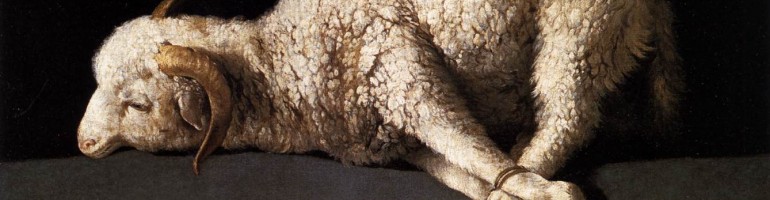
At/on the Cross, Jesus offered up to God his entire life/career of faithful obedience and sinless innocence, letting it get sacrificed by vicious sinners who did not recognize or admit his righteousness at all. They only wanted him dead, because of their own seething envy (Mt. 27:18; Mk. 15:10).
Through offering himself up to God Himself by surrendering himself to the forces of evil, Jesus put his fate in his Father’s just and capable hands to show who was really right in this sordid affair. By letting the sovereignties and authorities of the Jews and Romans play out their seemingly victorious hand to its ostensibly successful denouement, Jesus was submitting humbly to God’s own judgment…awaiting God’s own timing, and not, as he himself would have preferred, at the Cross or, better yet, even before the terrifying scenario ever started playing out—in fact, even prior to his being apprehended. For this “son of mankind” did not personally wish to drink this cup to its bitter dregs at all, yet faithfully acquiesced and left the outcome in God’s righteous hands, trusting his ultimate fate to the everlasting arms beneath the bloodied dramatic stage to break his fall. In due time God exalted him in graciousness—the identical graciousness in which he would “be getting to taste death for the sake of everyone” (Heb. 2:9). It is such unmatched human behavior that characterized Christ Jesus the “Prince of Peace” and proves credible the exhortation, “For Messiah’s sake, be conciliated to God!” (2 Cor. 5:20).
In antiquity, God on occasion accepted this voluntary offering—this “sin[-offering]” (hamartia—alike in 2 Cor. 5:21, Rom. 8:3, and throughout Leviticus, etc., in the Greek Septuagint)—“with fire from heaven,” visible even at Pentecost (Matt. 3:11; Luke 3:16; Acts 2:3), consuming “living sacrifices” (Rom. 12:1) as acceptable, sweet-smelling offerings made wholesome by God’s promised gift of the Spirit, besides justly compensating for Satan’s violent enormity against the Son of His love.
Adam’s one offense that brought death to the whole race of mankind was more than countered by Jesus’ one just award, repaid him by God the Judge as damages in fair exchange for Satan’s fatal assault, and which brought life superabundant and gratuitous to all who believe this stirring Proclamation! (Rom. 5:18) Adam’s disobedience constituted his many offspring as sinners, yet Messiah’s more-than-countervailing obedience, due to its evoking super-excessive and superabounding graciousness toward him from God (Rom. 5:15,17,20), through his mediation, nevertheless constituted a multitude of others also as just! (Isaiah 53:11, Rom. 5:19, 1 Peter 2:24) [4/7/06; 10/15/25]

 The Premial Atonement