Rachel Joy Scott sacrificed herself—an innocent, good (even when her five “good” friends were not, and abandoned her), forgiving, kind, spotless virgin (decisively giving up her boyfriend and giving up the hope of marriage) lamb (“rachel” in Hebrew) to become a sin-offering (αμαρτια) as a protection, shelter, or shield (ιλαστηριον—“propitiatory shelter,” “mercy-seat“) concerning the sins or offenses of her high school (particularly bullying). Not only that, but also concerning the sins of her parents in divorcing. Rachel’s willing, voluntary self-sacrifice in accordance with God’s desire, brought the overcompensation of God’s graciousness to her whole family, giving back to her father Darrell a vast ministry of salvation in high schools across the nation, along with her mother Beth (plus both of her parents’ new spouses), as well as her sisters and brothers.
Rachel Joy Scott, by her heroic self-sacrifice, also delivered Columbine High School from a manifold worse devastation than it did suffer in fact. Bombs placed in the cafeteria refused to detonate, thus sparing hundreds of lives! Only twelve students (“disciples”) and one teacher (“master”) died…although many more were wounded.
And God was pleased, well-pleased, propitious, gracious, and thousands more have been saved across the nation and beyond, as a consequence. [4/21/06—the 7th anniversary of the Columbine massacre; 12/31/25]
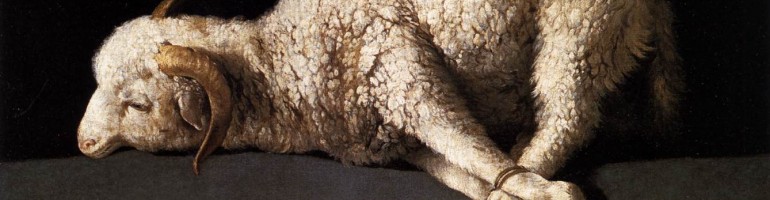
God, throughout the Old Covenant with Israel, required that the regular sin-offerings employ a flawless lamb (a virgin animal), white (“without spot”). Why? Obviously, to depict sinlessness. That being the case, the offering portrayed a sin against the creature itself—the harmless, amenable animal. This ritual act, in effect, depicted wrong or injustice, per se. In this precise way, the sin-offering (αμαρτια) truly did depict a sin (αμαρτια).
Thus did the sinless sacrificial victim bear “the string of sins,” in the words of Rachel Scott, Columbine High School martyr, leading up to its slaughter and death, by accepting all these injustices without complaint and without self-defense, vengeance, or retaliation.
Jesus had the right from his Father to not bear those brutal injustices—no one could have taken his life from him (John 10:17-18); he could have called more than twelve legions of angelic messengers to save himself if he had chosen. (Matt. 26:52-54) Yet many bystanders erroneously taunted, “Others he saves! Himself he cannot save!” (Matt. 27:42) Not! Rather, he carries their “string of sins“/”strings of sin” without reviling and without threat (1 Peter 2:23-25). By those savage “welts” we are healed (Isaiah 53:5), precisely because God avenged them by healing his flesh at resurrection, then proceeding to overcompensate him with superabundant healing for us in the bargain! (I love this Gospel, I do!) Jesus’ only choices were to avenge himself or to bear those sinful assaults. He willingly gave up what our sins had deprived him of. He chose to not avenge himself, to not vindicate his own honor, to not use his own authority, which he had direct from his Father. He laid it all down, surrendering himself instead into his Father’s hands—”Him Who is judging justly” (1 Peter 2:23). And that would mean, in the meantime, surrendering himself to his vicious enemies whom he loved, many of whom, by his subsequently demonstrated mercy and graciousness came to trust him after all and got saved!
The medieval notion that at the Cross God avenged His insulted honor is 180° backwards. Messiah bore or carried that dishonor instead of avenging himself (although the legitimate authority to do so had never been, nor could ever be, taken from him). He waited for Jehovah’s righteous judgment to avenge the enormity. It is from LOVE that the Savior died instead of lashing out in revenge to decimate his enemies. The supernal wisdom behind love aims at “winning souls” back to amity and friendship. God’s goal was not to incinerate the sinner but to conciliate the silly (from a word suggesting “deserving pity,” meaning feeble-minded, showing little sense, judgment, or sobriety; foolish, stupid, absurd, ludicrous, etc. [Colloq.]: dazed, senseless, as from a blow. [Dial.]: helpless, weak. [Archaic]: feeble, infirm. [Archaic]: simple, plain, innocent.).
To conclude, the ancient sacrificial lamb, appointed by covenant and well-pleasing to God, got consumed by fire—burning wrath, anger, indignation, fury. Yet dare we allege that these represented the disposition of God? The cross of “the Lamb of God who takes away the sin of the world” (John 1:29, 36) illuminates the truth that yields the true interpretation. That fiery holocaust depicts the furious hatred and wrath of Satan and the viciousness he propagates in the world. Yet the smoke rises “into God’s nostrils” as a memorial testimony of faithfully obedient submission depicted and figured by the unblemished lamb.
The raising up of the serpent in the wilderness onto a pole (John 3:14) likewise graphically symbolized the future crucifixion as a heinous sin. [4/21/06; 12/31/25]

 The Premial Atonement