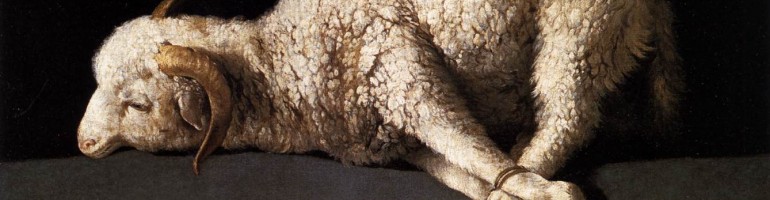
God never “imputed sin” to Christ. He did the diametric opposite. He imputed him righteous as over against all the weight of depraved human opinion and official judgment, although, to be sure, one of the crucified robbers finally came around, declaring to the mocker, “Yet you are not fearing God, seeing that you are in the same judgment! And we, indeed, justly, for we are getting back the deserts of what we commit [pra-], yet this One commits nothing amiss [atop-]” (Luke 23:41). Indeed, so did the centurion who saw him expire, who “glorified God, saying that, ‘really [ontos], this human was just!’” (Luke 23:47) and “truly [alethos], this human was a son of a god!” (Mark 15:39)—perhaps the best that could be expected from a Roman polytheist, but a worthy tribute nonetheless. Yet even the very man who betrayed the Master glorified God, at the last, admitting, “I sinned in surrendering innocent [atho–] blood” (Matthew 27:4). And that’s not all. Pilate himself, who convicted him under duress, glorified God by declaring, “Innocent am I of the blood of this just One” (Matthew 27:34). Thus far the insignificant minority. But the mob and all their leaders imputed sin to the flawless, blameless Lamb of God, whose sinlessness made him worthy to buy us for God. YET GOD JUSTIFIED HIM BY RESURRECTION, THUS IMPUTING HIM RIGHTEOUS! [8/21/07]
Modern evangelical theologians have much to learn about glorifying God from thieves, traitors, executioners, and oppressive pagan rulers. [8/24/08]
Did Jesus “pay the Devil” the ransom of his just soul in order to free and liberate mankind? No, he paid Death, but since death was in Satan’s control (his “ultimate weapon,” the “last enemy”) when Messiah Jesus, the Lord, conquered death by winning life and rising from the dead, the Adversary—that “Great Dragon,” the “Old Serpent”—was defanged, declawed, disarmed, and defeated…all but dismembered! Jesus, in effect, did an end run around the opposing horde of bruisers when he ran for the goal yet allowed Death to tackle him en route. However, this particular “block and tackle” maneuver worked in reverse to hoist the Old Monster on his own gibbet, having been lured by his own greed to use his ultimate weapon to swallow the innocent bait—the divine Offspring of the Creator Himself. Thereby Satan tricked and tripped and trapped himself! [8/21/07]
The classic case against “penal substitution” was enunciated by Faustus Socinus (1539-1604), the Italian émigré who became a de facto leader of the evangelical unitarian Polish Brethren during the century of the Reformation. He was, in the main, quite correct in his objections and remains among the most eloquent opponents of the Reformers’ severe innovations upon Anselm (1033-1109). So whenever we hear the cry, “Socinian!” we can usually be sure we are hearing the squeal of a defender of penal substitution. The same squeal was heard endlessly during the decades of the English civil wars, 1640s and 1650s. The squeal went up later against Barton W. Stone (1772-1844), co-founder of the Stone-Campbell or Restorationist movement in America in the early 19th century (from which stems the Church of Christ / Churches of Christ / Christian Church / Disciples of Christ family of churches). It may have been heard in the ears of Frederick Denison Maurice (1805-72), and probably by George MacDonald (1824-1905), the beloved novelist and children’s author. It was certainly heard by Paul Peter Waldenström (1838-1917). The frightful shriek goes up again and again from those who imagine that a denial of error must always be followed, as cause by effect, with the further acceptance of the errors of the deniers. Not so. The tandem fear that a confession of our own errors must be followed by a denial of our hard-won truths is similarly unwarranted. But the only way to pass through the horns of the dilemma gracefully is via resurrection, that is, by way of restorative justice! Penal justice can only evoke squeals and shrieks. [89/23/07]

 The Premial Atonement